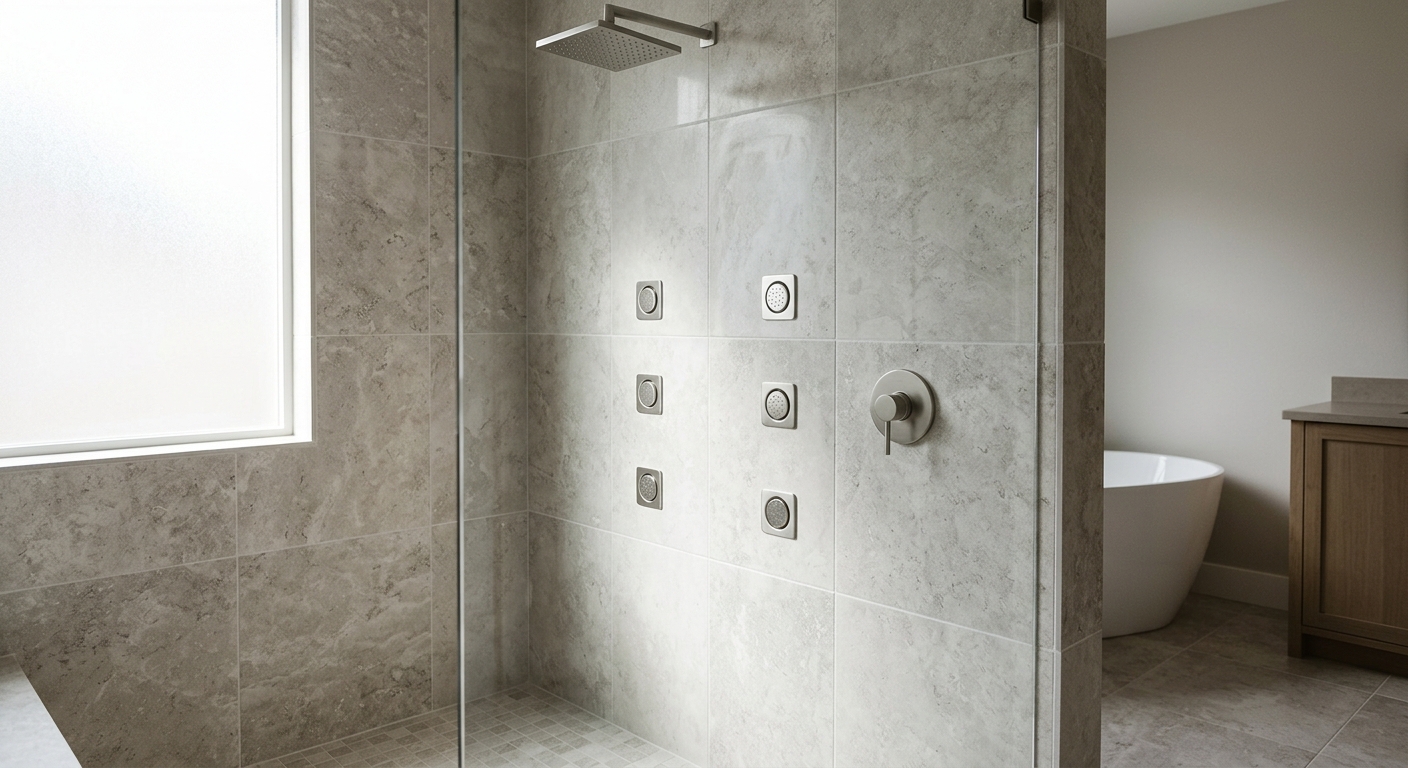
Body jets are worth the plumbing cost only if the valve, manifold, and supply line behind the wall can deliver enough water to run them alongside the head and handheld without starving any of the three. That’s a rough-in and flow-rate question before it’s a comfort question. If your system can’t hit the combined GPM, you end up with weak jets, a stuttering head, or a compromise where you’re only ever running one outlet at a time, which defeats the point of buying jets in the first place.
What Body Jets Demand From the Valve
Every additional outlet on a shower system adds load to the valve, and the valve’s job is to hold temperature and pressure steady no matter how many outlets are open. This is where the difference between thermostatic and pressure-balancing valves actually matters, not as a spec sheet line but as lived behavior in the shower.
A pressure-balancing valve keeps the hot-to-cold ratio constant by reacting to pressure changes on either the hot or cold side. It works fine for a single outlet or two outlets with modest combined draw, but when you open a third or fourth outlet, the valve has to fight harder to keep that ratio balanced. You’ll feel it as a temperature dip or a slow drift when jets kick on.
A thermostatic valve reads actual water temperature, not just pressure ratio, and adjusts the hot/cold mix accordingly. Under multi-outlet load, this makes it more stable. For any system with body jets running simultaneously with a head and handheld, thermostatic is the safer spec. Pressure-balancing can work in a two-outlet system, but once you’re routing water to four or more places at once, thermostatic control gives you a wider margin before someone standing in a body jet spray notices a temperature swing when another outlet opens.
GPM Math: Jets Plus Head Plus Handheld
The math is simple once you have the numbers, and the numbers are what most homeowners skip. A standard shower head is capped at 2.5 GPM federally, 1.8 GPM in California and a handful of other states with their own standards. A handheld typically runs close to the same range, often 1.8 to 2.5 GPM depending on the model. Body jets are not federally capped the way heads are, and they typically run 2 to 4 GPM per jet depending on nozzle size and design.
Add it up. A system with one head, one handheld, and four body jets could look like this if everything is running at once:
- Shower head: 2.5 GPM
- Handheld: 2.0 GPM
- Four body jets at 3 GPM each: 12 GPM
- Total demand: 16.5 GPM
That number matters because a typical 3/4 inch supply line has a practical delivery capacity in the range of 10 to 12 GPM at normal residential pressure, depending on pressure at the meter, pipe length, and how many fittings and elbows are between the main and the shower. A 1/2 inch NPT connection at the fixture end narrows things further. If your rough-in is feeding this system off a 3/4 inch line, you are already short before you account for other fixtures pulling from the same branch.
This is why most functional body jet systems are designed around partial simultaneous use, not full simultaneous use. A well-specified system lets you run the head and two jets together, or the handheld and all four jets, but reserves full six-outlet operation for a diverter setting you rarely use. If a system spec sheet promises unrestricted full-flow operation across every outlet at once, ask what supply line size and static pressure that claim assumes, because it is not achievable on a standard residential 3/4 inch line without a booster pump or a larger main.
Manifold and Diverter Options for Multi-Outlet Systems
The diverter is what decides which outlets get water and how much, and the type of diverter you spec changes what’s actually possible in the wall.
| Diverter Type | How It Works | Best Fit |
|---|---|---|
| 3-way | Routes flow to one of three outlets, or split between two, using a single handle | Simple systems: head, handheld, one body jet zone |
| 6-way | Controls up to six outlets from a single valve trim, often with sequential or combination settings | Systems with multiple jet zones plus head and handheld, moderate supply capacity |
| Manifold-style | Uses a dedicated distribution manifold behind the wall, often with individual volume controls per outlet | Full body jet systems where independent flow control per jet or per zone is required |
A 3-way diverter is fine for a head-plus-handheld system with no jets, or one jet zone. Once you’re running four or more jets in addition to a head and handheld, a manifold-style setup gives you the most control, because it lets you dial back flow to specific jets rather than relying on the diverter to just turn zones on and off. That control is what makes a marginal supply line workable, since you can run jets at reduced volume instead of full GPM and stay within what the line can deliver.
Wall Cavity and Rough-In Realities
Body jets are not a trim-level decision. Every jet needs its own supply line run through the wall cavity back to the manifold or diverter, and that run has to be planned before drywall goes up. A 2×4 wall gives you roughly 3.5 inches of depth to work with once you account for the stud and any blocking, which is workable for individual jet supply lines but tight if you’re also running a large-format valve body or manifold assembly in the same cavity. Many multi-outlet systems end up specified for a 2×6 wall specifically to give the manifold and its fittings room to sit without being crushed against the finish surface.
Rough-in also means committing to jet placement before tile goes on, since jets are typically set at torso height in a pattern that doesn’t move once it’s plumbed. If you’re gutting a shower anyway, this is the point where reviewing complete shower systems as a matched valve, head, handheld, and jet package makes sense, since it lets your plumber size the manifold and supply runs to the system’s actual combined GPM instead of guessing at compatibility after the fact.
Water heater capacity is the other piece people forget. A tankless unit or tank sized for a single shower head runs into trouble fast when it has to supply 15+ GPM of hot water on demand. Check your water heater’s flow rate at your target temperature rise before committing to a jet count, not after.
When a Simpler System Makes More Sense
If your existing supply line is 1/2 inch or your main service is undersized for the house, adding four body jets to a system means either living with weak flow everywhere or paying to upsize the line, which usually means opening more wall than a straightforward shower renovation calls for. In that situation, a head and handheld on a thermostatic valve, or a head and handheld plus one or two jets rather than a full bank, gets you most of the experience without demanding plumbing work the house wasn’t built to support.
Before you sign off on a body jet system, get the actual numbers: your static water pressure, your supply line size from meter to shower, and your water heater’s flow rate at temperature. A plumber can measure static pressure in about five minutes with a gauge on an outside spigot. If those numbers support 15+ GPM at your target temperature, spec the jets and the thermostatic valve to match. If they don’t, scale the jet count to what the line can actually deliver, or plan the line upsize as part of the same job instead of finding out after the tile is set.