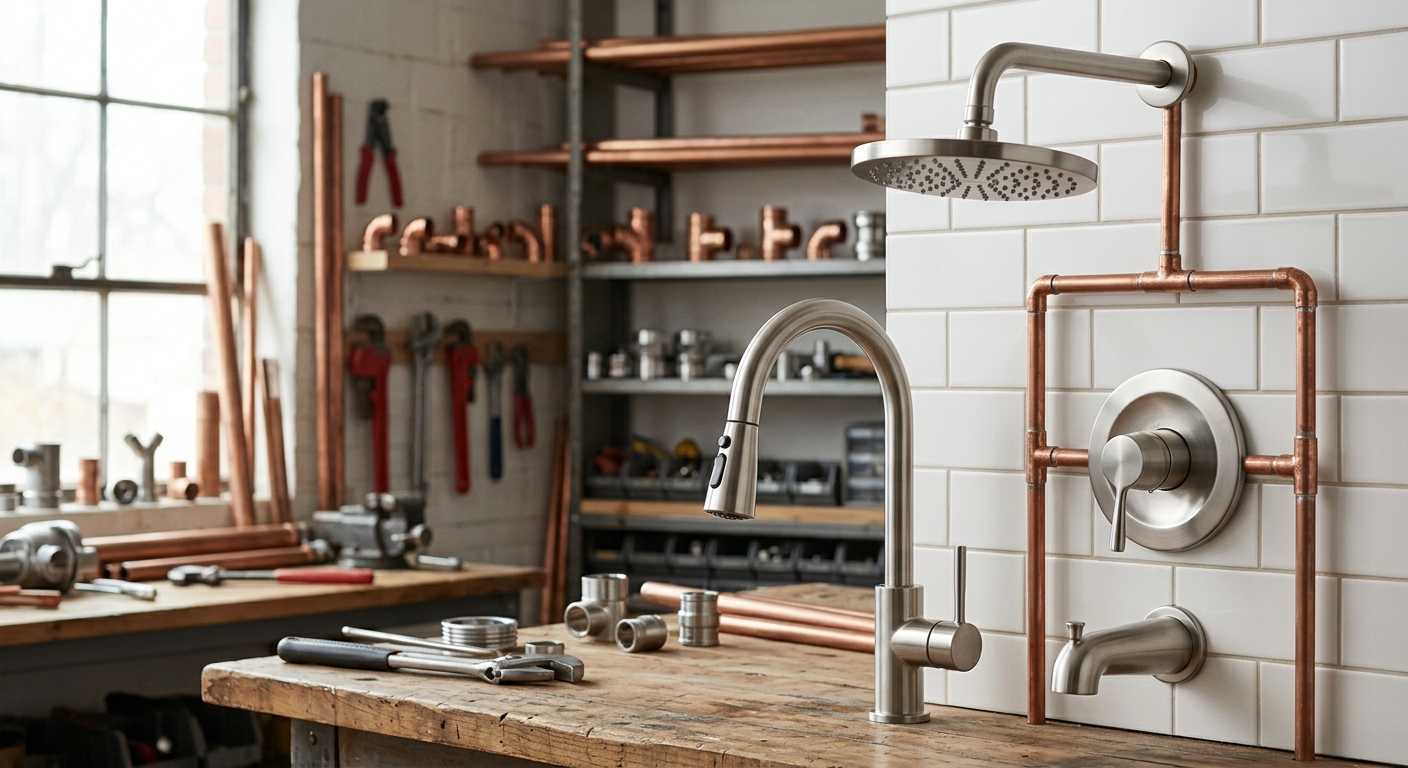
Matching finishes across the house is the easy part. The problem is that a shower system with a rain head, handheld, and body jets can draw more water than your supply line and water heater were sized to deliver at once, especially if you’re also running a kitchen faucet on the same branch. Before you pick brushed nickel or matte black for every room, work out the flow budget. Finish selection should happen after the math, not before it.
Why Finish Matching Alone Isn’t Enough
A whole-house fixture plan built only around finish and silhouette will get you a bathroom that looks coordinated and a shower that goes cold or weak the moment someone runs the kitchen tap. Finish is a surface decision. Flow rate, pressure, and valve type are load decisions, and they have to be settled at the rough-in stage, long before anyone compares trim kits. If you’re specifying a multi-outlet shower system alongside new kitchen fixtures, treat the shower as a load center with its own GPM number, then check that number against your service line and heater before you fall in love with a finish.
Your Shower System’s Real Flow Budget
Each outlet on a shower system has its own rated flow, and they add up fast once you move past a single showerhead. Federal law caps shower heads at 2.5 gpm, and California-compliant fixtures are capped at 1.8 gpm. A handheld sprayer typically runs another 1.8 to 2.5 gpm. Body jets are the real budget-breaker: each one commonly flows 1.5 to 2.5 gpm, and four of them running with a head and handheld can push total system draw past 6 gpm even when every individual component is code-compliant.
- Showerhead: up to 2.5 gpm (1.8 gpm in California)
- Handheld sprayer: roughly 1.8 to 2.5 gpm
- Body jets: roughly 1.5 to 2.5 gpm each, times the number installed
- Four-jet system plus head and handheld: often 6+ gpm combined
That total is what your valve, supply line, and water heater have to support simultaneously if the homeowner wants everything running at once, which is usually the point of buying a multi-outlet system in the first place. If the plan is to only ever run one outlet at a time, say so to your plumber explicitly, because it changes the valve and line sizing.
Water Heater Recovery and Simultaneous Use
A shower system drawing 6 gpm of mixed hot and cold water needs sustained hot water delivery, not just hot water capacity. Tank water heaters are rated by first-hour rating and recovery rate; tankless units are rated by a flow rate at a given temperature rise. A tankless unit that comfortably handles a single 2.5 gpm showerhead can fall short feeding a full system plus a kitchen faucet running at the same time, particularly in colder climates where incoming water is colder and the unit has to work harder for the same temperature rise.
This is also where kitchen draw matters. A standard kitchen faucet flows around 1.5 to 1.8 gpm at 60 psi. That’s modest next to a multi-outlet shower, but if someone’s running the dishwasher, washing machine, and kitchen faucet while the shower is on, you’re stacking demand on the same water heater and possibly the same branch line. Before finalizing a shower system spec, ask your plumber or the water heater manufacturer’s sizing tool whether the unit covers your worst-case simultaneous draw, not just the shower alone.
Matching Trim Families Room to Room
Once the flow budget is sound, finish coordination is straightforward. Match the finish and trim family, brushed nickel, matte black, polished chrome, across the shower valve trim, shower arm, handheld bracket, and kitchen faucet, and keep hardware (cabinet pulls, towel bars) in the same family so the metals read as intentional rather than accidental. Where kitchen duty cycle is heavier than residential, such as a home with a large family or a lot of entertaining, it’s worth looking at commercial kitchen faucets built for continuous use, since the mechanism underneath a matching finish matters as much as the finish itself.
A few things to check before you order trim across rooms:
- Confirm the finish name matches, not just the color in a photo. “Brushed nickel” varies between manufacturers.
- Check handle style compatibility, lever versus cross handle, especially if the shower valve and kitchen faucet come from different product lines.
- Verify escutcheon size and shape if you’re trying to keep a single aesthetic language between the shower valve plate and any exposed kitchen supply lines.
Rough-In Valve Specs vs Kitchen Supply Lines
Both the shower valve and the kitchen faucet connect to 1/2 inch NPT supply, which is the standard rough-in thread across nearly all residential fixtures in the US. That shared standard makes supply-side compatibility a non-issue; the valve body and the way it distributes flow to multiple outlets is where shower systems diverge from a single kitchen faucet.
Any shower system with more than one outlet needs a pressure-balancing or thermostatic valve rated to ASSE 1016. This standard governs how the valve responds when something else in the house, like a toilet flushing or the kitchen faucet opening, pulls cold water pressure down mid-shower. A pressure-balancing valve maintains the hot-to-cold ratio by restricting flow on the side with less pressure drop. A thermostatic valve goes further, holding a set output temperature regardless of inlet pressure or temperature swings, and is generally the better choice for systems running a head, handheld, and multiple body jets simultaneously, since it’s managing a bigger spread of outlets and a larger combined draw.
Don’t assume any pressure-balancing valve is rated for a four-outlet system. Confirm with the manufacturer’s flow rating that the valve body is sized for your total combined gpm, not just a single showerhead.
Writing a Whole-House Fixture Spec Sheet
Before you order anything, put the numbers on paper. A simple table like this makes it easy to catch a mismatch before the plumber is standing in your bathroom with fixtures that won’t work together.
| Fixture | Flow Rate (gpm) | Connection | Valve/Rating Requirement |
|---|---|---|---|
| Showerhead | up to 2.5 (1.8 in CA) | 1/2 in NPT | ASSE 1016 valve upstream |
| Handheld sprayer | 1.8–2.5 | 1/2 in NPT | Shares shower valve |
| Body jets (each) | 1.5–2.5 | 1/2 in NPT | Shares shower valve, confirm valve gpm rating |
| Kitchen faucet | 1.5–1.8 at 60 psi | 1/2 in NPT | Standard compression or quick-connect |
Add up the shower system’s outlets, confirm the valve is rated for that combined total, then check the water heater’s recovery rate and the kitchen faucet’s draw against the same branch line. Only after those numbers clear should finish and handle style enter the conversation.
What to Check Before You Order
Pull the spec sheet for every shower outlet you’re considering and add the gpm figures together, not just the showerhead. Compare that total against your water heater’s rated output at your incoming water temperature, and confirm the valve you’re buying is ASSE 1016-rated for that combined flow, not a single-outlet rating. If you’re unsure whether your home’s water heater or supply line can support a four-jet system plus a handheld, have a plumber run the numbers before you commit to trim finishes. It’s a short conversation up front and it avoids a shower that looks right and performs poorly.