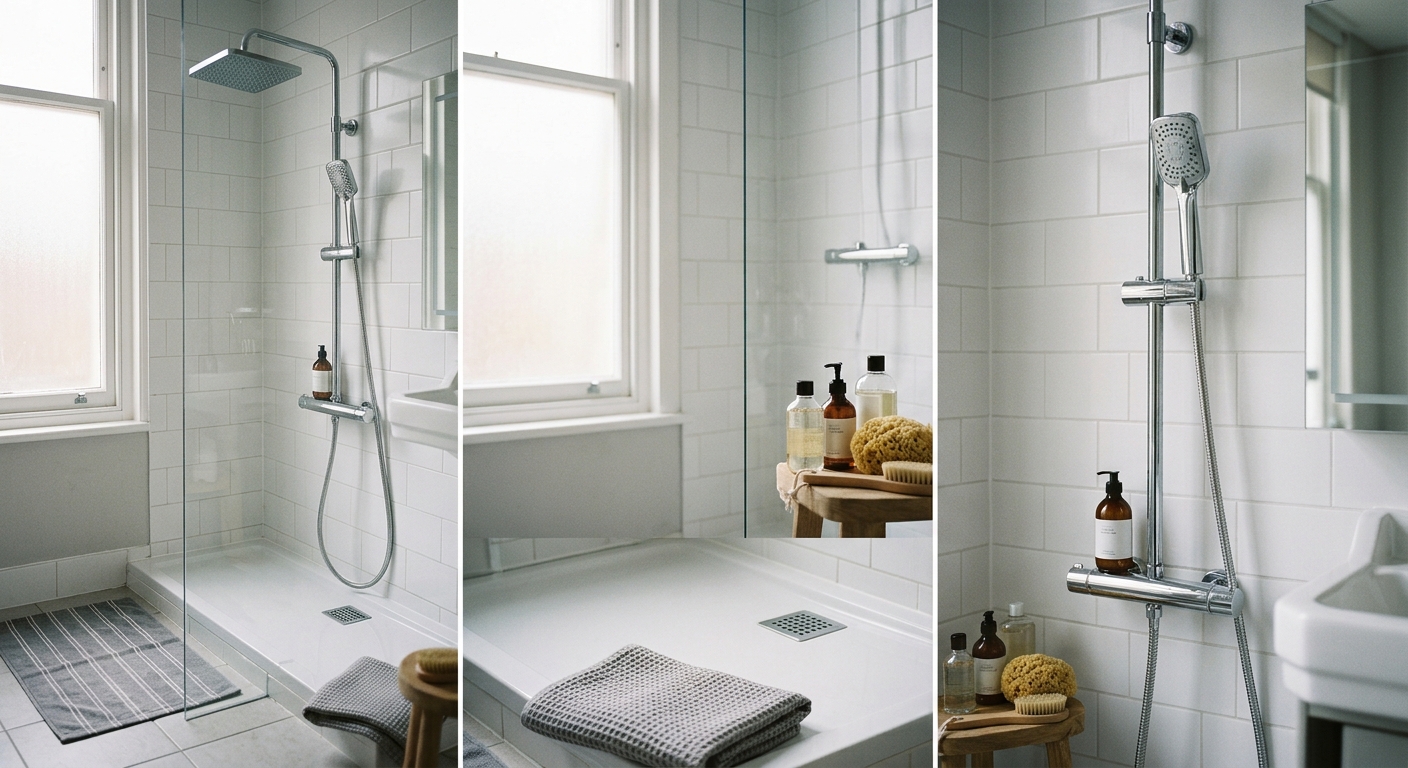
Yes, you can upgrade your whole shower experience without touching the valve. The showerhead, handheld, hose, and slide bar are all downstream connections that thread or slip onto existing hardware. The valve body and cartridge are the only parts actually plumbed into the wall, and those are the only parts a landlord will care about.
What You Can Actually Swap as a Renter
The line between “fixture” and “plumbing” matters here. A valve is set into the wall with solder, press-fit, or threaded fittings, and swapping it means cutting into tile or drywall. That is a landlord’s job, not yours, and most leases are explicit about it. Everything downstream of the valve outlet, though, is designed to be removable by hand or with a wrench, no soldering or sealant required beyond plumber’s tape.
- Showerhead: threads directly onto the shower arm, swappable in minutes.
- Handheld and hose: connect to a diverter or a slide bar mount, also threaded.
- Slide bar: can be wall-mounted without drilling if you use a slip-fit or tension-mounted bracket instead of screws.
- Valve trim, cartridge, rough-in: off limits. Leave these alone.
If your lease requires written permission for any fixture change, a shower system swap is one of the easier asks, since nothing permanent happens to the wall or the plumbing behind it.
Matching Flow Rates to the Existing Valve
Every valve has a rated flow capacity, and if you install a head or handheld that exceeds it, you will get weak, inconsistent pressure no matter how good the fixture is. Most residential valves built in the last two decades are rated to handle the federal maximum of 2.5 gallons per minute per outlet, but older valves, especially in buildings from before the 1990s, may flow less.
The showerhead itself is also capped by regulation. Federal law limits shower heads to 2.5 GPM; California and a handful of other states and utilities enforce a WaterSense standard of 1.8 GPM instead. If you are swapping a head in a state with the stricter cap, or if your building already supplies low-flow water, buying a 2.5 GPM head will not get you more water, it will just mean the valve is the bottleneck instead of the head.
Check the flow rate stamped on your existing showerhead before you buy a replacement. If it says 1.8 GPM, match it. If you’re unsure, assume 2.5 GPM is safe for any valve installed after approximately 1994, when the federal standard took effect.
Buying the Head and Handheld as a Matched Kit
The thread standard that matters here is 1/2 inch NPT, sometimes labeled G1/2, which is the connection size used on nearly every US shower arm and handheld hose. This is a tapered pipe thread, not a hose thread, so it seals with a few wraps of PTFE tape rather than a rubber washer. Almost any head or handheld sold in the US for residential use will fit this threading, which is why matching finish and flow matters more than matching thread size.
Buying the showerhead and handheld as a packaged kit, rather than piecing them together separately, solves two problems at once. First, the finish will actually match, brushed nickel next to brushed nickel, not two different shades of “stainless.” Second, the flow rates are usually balanced by the manufacturer so the diverter splits water evenly instead of starving one outlet. If you’re looking at thermostatic shower systems as a reference point for how head, handheld, and valve trim are specified together, it’s worth noting that even in a rental where you can’t touch the valve, buying the head and handheld components as a set still gets you that same coordinated result downstream.
When comparing kits, check these specs side by side:
| Spec | Why it matters for a rental |
|---|---|
| Thread size | 1/2 inch NPT fits nearly all US shower arms; confirm before buying if the apartment is older or imported fixtures were used |
| Flow rate (GPM) | Match to existing head or valve rating, 1.8 or 2.5 GPM |
| Finish | Match to existing valve trim, not just the shower arm, since trim and head are usually visible together |
| Hose length | Standard is 60 inches; longer hoses help with slide bar height adjustments |
| Mounting hardware | Look for slip-fit or tension brackets if you don’t want to drill |
Reversible Slide Bar Mounts
A slide bar is what lets the handheld move up and down the wall, and it is usually the part of the system people assume requires drilling. It doesn’t have to. Slip-fit slide bars clamp onto the existing shower arm or use a tension bracket against the tile, holding the bar in place with friction and a rubber or silicone pad rather than screws.
These mounts hold up fine for daily use, but they are not meant for someone to lean on or grab while stepping in and out of the tub. If balance is a concern, a screwed-in grab bar is a different product entirely and that conversation belongs with your landlord, not a rental-friendly shower kit.
When you do find a slip-fit bracket, check the clamp diameter against your shower arm before ordering. Most US shower arms are 1/2 inch NPT on the valve end but have a slightly larger outer diameter at the point where a bracket would clamp, typically around 3/4 inch to 1 inch. A bracket sized for the wrong diameter will either not close or will slip under water pressure.
Boxing the Original Fixtures for Move-Out
Keep the landlord’s original showerhead, handheld, and any mounting hardware in a labeled box, ideally the same box your new fixtures arrived in. Include the original showerhead, handheld, hose, and any wall brackets, plus whatever plumber’s tape or washers came with them if they’re distinguishable from your own hardware. Store it somewhere it won’t get thrown out during the lease, a closet shelf or under-sink cabinet works.
At move-out, unscrewing your kit and reinstalling the originals takes the same few minutes the original swap did. Wipe down the shower arm threads, wrap fresh plumber’s tape if the old tape tore off, and hand-tighten the original head back into place. This is the step that protects your deposit, since most move-out inspections check that fixtures match what was documented at move-in, not that fixtures are new.
Before You Buy
Check the flow rate on your current showerhead, measure the shower arm’s outer diameter if you want a slide bar, and confirm your lease doesn’t flag fixture swaps as a no-go without notice. If the valve itself leaks, drips, or doesn’t hold temperature, that’s a maintenance request to your landlord, not a project for a rental-friendly kit. Everything else, head, handheld, hose, and slide bar, is yours to upgrade and yours to pack up when you leave.